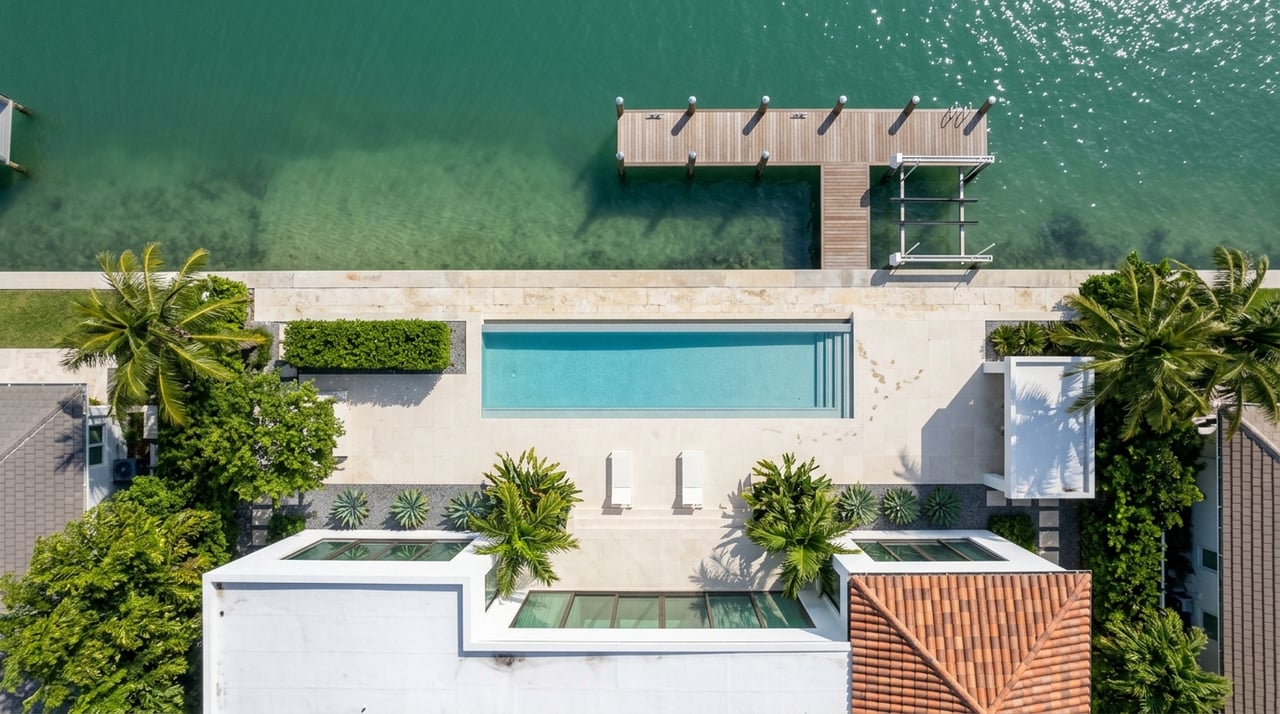
If you look at Star Island and wonder why prices can leap from the mid-eight figures to well above $100 million, you are asking the right question. This is not a market where a simple price-per-square-foot shortcut tells the full story. To understand Star Island, you need to look at scarcity, land, views, waterfront utility, and the tiny set of sales that shape value. Let’s dive in.
Why Star Island behaves differently
Star Island is an unusually small and tightly defined waterfront enclave in Miami Beach. Architectural Digest describes it as an 86-acre artificial island completed in 1922 with roughly 30 waterfront homes, no dry homes, one causeway entrance, and security screening at the gate.
That setup matters because it creates a rare kind of supply constraint. There are only a handful of homes, every property is tied to the waterfront lifestyle, and turnover is limited. In practical terms, buyers are not shopping a broad neighborhood. They are competing for a trophy micro-market.
This is why Star Island often trades more like a private inventory pool than a typical residential area. When a truly special property becomes available, there may be no close substitute nearby. That scarcity is one of the clearest reasons pricing can rise so sharply.
Land drives Star Island pricing
On Star Island, the lot is often the main event. The home itself matters, of course, but the land envelope can be the core source of value.
Miami Beach planning records for 10 Star Island Drive show that RS-1 lots require at least 30,000 square feet and 100 feet of width. The same records note that the site was split into three 40,000-square-foot parcels and that surrounding RS-1 lots averaged 45,217 square feet.
That tells you something important. In a market this small, lot size and width are not minor details. They shape what can be built, how a home can sit on the site, and how much waterfront presence the property can command.
A 2023 Design Review Board filing for 28 Star Island Drive also described a rectangular waterfront lot of about 40,000 square feet. When buyers evaluate Star Island, they are often valuing the site’s geometry and future flexibility as much as the current house.
Why lot width matters
Wide lots can create a stronger sense of scale from both the street and the water. They may also support a more expansive home footprint, broader water exposure, and a more dramatic arrival experience.
In a market with roughly 30 homes, those differences can have an outsized pricing effect. A lot that feels meaningfully larger or more usable can separate itself quickly from the rest of the island.
Views can change the value equation
Not all waterfront views perform the same way in the market. On Star Island, orientation can materially affect how a property is perceived and priced.
The $75 million sale of 8 Star Island Drive offers a strong example. Miami Herald reported that the broker tied the lot’s appeal to its eastern position, which cleared Hibiscus and Palm Islands and captured views of the Miami skyline, Coral Gables, and more.
That is a major pricing clue. Buyers at this level are often paying for a visual experience, not just square footage or finishes. A cleaner, wider, or more dramatic view corridor can elevate a property far beyond what a simple neighborhood average would suggest.
The premium on view corridors
On a trophy waterfront island, small shifts in placement can create big differences in sightlines. A property with broader skyline exposure or a more open bay perspective may command a significant premium over a home with a more limited orientation.
This helps explain why two homes on the same island can trade at very different levels. The value stack is not just about the structure. It is about what you see, how open it feels, and how rare that perspective is.
Dockage and waterfront use matter
Waterfront living on Star Island is not only about scenery. It is also about usability.
City planning staff noted that existing docks on 10, 11, and 12 Star Island Drive had to be modified or removed to comply with setback rules. That detail shows two things at once: dockage is valuable, and it can involve meaningful regulatory considerations.
In another example, Miami Herald described a 2021 Star Island project proposal that included a boat dock, lounge area, and two pools overlooking Biscayne Bay. This reflects how marine access and bayfront living are built into the island’s luxury appeal.
Waterfront utility adds another layer
For buyers who value boating and direct bay access, seawalls, docks, and marine setup can influence pricing in a very real way. A property that combines strong views with functional dockage may appeal to a narrower but especially motivated buyer pool.
That does not mean every property is valued the same way. It means waterfront utility becomes another premium variable in a market already defined by scarcity.
Architecture still plays a role
Even in a land-driven market, architecture matters. Star Island has longstanding design pedigree, and that history contributes to its identity.
Architectural Digest notes that the island’s first residence was designed by Walter de Garmo and built in 1924. The same reporting says many older homes were built for luxury ahead of their time and that many properties are gutted and updated rather than simply traded as-is.
For buyers and sellers, this means pricing can reflect more than age or condition alone. Design history, renovation potential, preservation considerations, and rebuild possibilities can all shape how a property is positioned in the market.
The comp set is tiny
One of the biggest mistakes you can make with Star Island is treating it like a normal neighborhood where dozens of recent sales establish a clean pricing range. That is not how this market works.
Recent transactions show how concentrated and headline-driven the comp universe really is. Miami Herald reported that 8 Star Island Drive sold for $75 million and, at the time, set a Miami-Dade County house sale record.
The Real Deal reported that Rick Ross bought 37 Star Island Drive for $35 million in 2023, with the property offering 100 feet of Biscayne Bay frontage and a 40-foot dock. Then in March 2025, Bloomberg reported that 26 Star Island sold for $120 million, setting a new Miami-Dade record.
Those numbers tell you a lot. This is a market where one extraordinary sale can meaningfully influence expectations because there are so few comparable trades to reference.
Why one sale can move the conversation
In a larger neighborhood, a single record sale may be an outlier. On Star Island, it can become a major benchmark because the inventory is so limited.
Miami New Times reported that Star Island has around 30 homes and that the $120 million property at 26 Star Island sat on 2.5 acres with a dock, pool, and tennis court. That kind of asset is not only rare on the island. It is rare across all of Miami-Dade.
Star Island vs. broader Miami Beach
To price Star Island correctly, you have to resist the temptation to compare it too closely to broader Miami Beach numbers. The wider market provides context, but it does not define this island.
MIAMI Realtors reported that Miami Beach’s single-family luxury threshold reached $27.5 million in 2025 and its uber-luxury threshold reached $45.6 million. The same report said Miami Beach led Miami-Dade in $10 million-plus single-family sales.
Even with that strong luxury backdrop, Star Island’s recent transactions still sit far above the city’s own luxury thresholds. That is the clearest sign that Star Island should be treated as its own pricing ecosystem.
For even broader contrast, MIAMI Realtors reported that Miami Beach single-family sales rose 9.8% in the first quarter of 2025 and that the area’s median sale price reached $4.5 million. Realtor.com’s December 2025 market summary placed Miami Beach’s median home price at $669,000 and described the citywide market as a buyer’s market.
Those figures are useful because they highlight the gap between the general market and the trophy tier. Star Island does not move in lockstep with citywide averages. Its pricing is shaped by land, views, waterfront utility, privacy, and a very small number of high-impact comps.
What defines ultra-luxury pricing here
If you want the simplest explanation, Star Island is a land-and-view market first. The most important variables tend to be:
- Scarcity of inventory on an island with roughly 30 homes
- Waterfront-only housing stock
- Lot size, width, and overall buildable envelope
- Orientation and quality of view corridors
- Dockage, seawalls, and marine usability
- Architectural pedigree, renovation upside, or rebuild potential
- A tiny, headline-driven sales comp set
When these factors align in one property, pricing can move into a different category altogether. That is why the island can produce values that appear disconnected from typical Miami Beach metrics.
Why careful pricing strategy matters
For sellers, Star Island demands more than a standard comparative market analysis. Positioning has to account for the property’s exact site characteristics, visual experience, waterfront function, and where it fits within the island’s narrow hierarchy of homes.
For buyers, understanding the pricing logic helps you see why one property may justify a large premium over another. In this segment, the difference is often not cosmetic. It is embedded in the land, the orientation, and the rarity of the opportunity.
That is where an analytical approach becomes especially valuable. In a market this thinly traded, careful price discovery and nuanced property storytelling matter just as much as broad market awareness.
If you are considering buying or selling in Miami’s trophy waterfront market, working with an advisor who understands how ultra-luxury value is built can make all the difference. Connect with Jennifer Brilliant for thoughtful guidance, local market perspective, and a tailored strategy for exceptional coastal real estate.
FAQs
What makes Star Island different from other Miami Beach neighborhoods?
- Star Island is a much smaller waterfront enclave with roughly 30 homes, one causeway entrance, security screening, and no dry homes, which creates an unusually scarce and private inventory pool.
What factors influence Star Island home prices most?
- The main pricing drivers are lot size and width, buildability, view corridors, dockage and marine access, architectural pedigree, and the small set of recent headline sales.
Why are Star Island prices often higher than broader Miami Beach prices?
- Star Island operates as a trophy micro-market where irreplaceable waterfront land, privacy, limited supply, and rare comps matter more than broader Miami Beach averages.
How important are views for Star Island property values?
- Views are highly important because orientation can change skyline exposure, openness, and overall visual impact, which can materially affect what buyers are willing to pay.
Do recent record sales affect Star Island pricing expectations?
- Yes. Because the island has so few sales, major transactions like the reported $75 million and $120 million deals can carry more weight than a single sale would in a larger market.